Website Strategy
Get More Discovery Calls Booked From Your Website

What if your website could do more than just make your business look professional?
What if it actually helped you turn interested prospects into booked discovery calls with people who are excited about working with you?
As a coach or consultant, you probably already spend a lot of time trying to get in front of potential clients. You're posting content, building relationships, networking, and doing everything and anything you can to get your business noticed.
But getting someone's attention is only half the battle. You also need to turn that attention into trust, and actually get a potential client to take the next step toward working with you. And that's the job of your website.
When it's built with the right strategy, your website can become a really useful marketing and sales tool. Your website can help you:
- Turn more of your existing marketing efforts into qualified leads.
- Build trust with potential clients before you ever speak to them.
- Get more discovery calls booked with people who already understand what you do and why they need your help.
And ultimately, having more of the right people reaching out can help you grow your business without constantly feeling like you're chasing your next client.
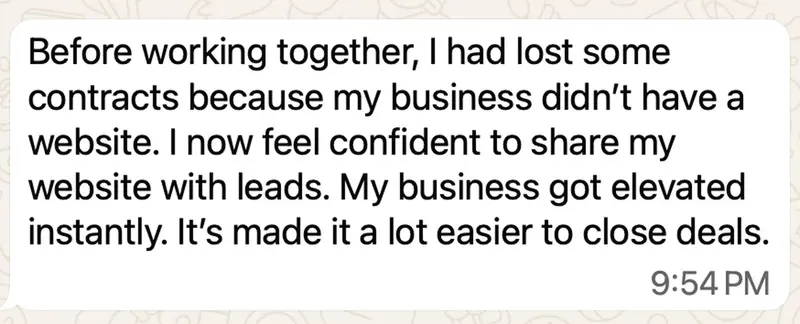
That's what happened for my client Temima, a LinkedIn ghostwriter. She launched her new website after a 6-month break from taking on new clients, and in her words: "Within just 14 days, I closed $13K in sales. I also finally landed my highest-ticket client, something I had been trying to do for 3 months before launching the new website."
The problem is that simply having a good-looking website isn't enough to make this happen. You can have a beautifully designed website and still not get a single lead.
Your website needs to be built on purpose to move someone from "I'm interested in what this person does" to "I want to talk to them about working together."
In this post, I'm sharing three strategies to help you turn your website into a sales and marketing tool that builds trust, attracts right-fit prospects, and gets more discovery calls on your calendar.
Ready? Let's get into it.
Strategy #1: Make Your Website Do More of the Selling for You
Let me ask you a question: when someone lands on your website, how quickly can they understand what you do, who you help, and why they should choose you?
If the answer is "not very quickly," your website is probably costing you clients.
Nobody is visiting your website to admire your design chops. They're trying to figure out one thing: "Can this person help me solve my problem?"
And before they're ready to book a discovery call, they usually need to feel confident that the answer is a clear yes. This is where two parts of a website that works come into play: clarity and credibility.
Clarity helps potential clients understand what you do, who you help, and how you can help them. Credibility gives them a reason to trust that you can actually deliver on what you're promising. Together, they turn your website into a tool that supports your sales process.
Show potential clients that you deeply understand their problem
One of the biggest mistakes I see consultants make with their websites is focusing too much on themselves, and jumping right into their own background or credentials. Those things are important, but they're not what your potential clients care about the moment they land on your site.
Don't get me wrong, I do believe in talking about you and your story, but that comes way after everything else. First they need to actually see how your service is going to solve THEIR problem.
That's why your website should start by clearly communicating:
- Who exactly is it that you help?
- What painful problems do you help them solve?
- What result can they expect when working with you?
When someone lands on your website and immediately recognizes the problem they're dealing with, they stick around to see if you can help them solve it.
Because now, instead of wondering whether they're in the right place, they're thinking: "Wait a minute, this person understands exactly what I'm dealing with."
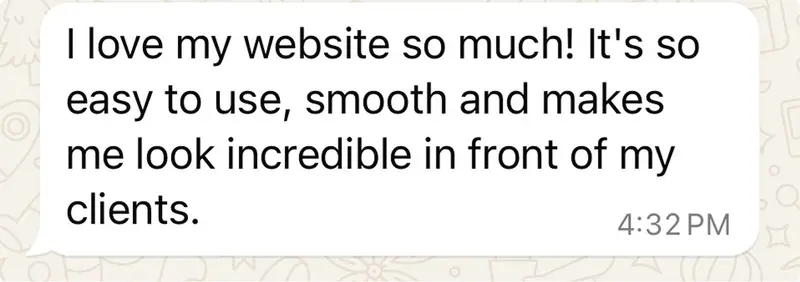
As my client Devora put it: "Potential clients are able to look at my site and know right away what I do and how I can help them."
Build a simple and clear roadmap of how you can help them
Once someone understands that you can help with their problem, the next question becomes: "How are you going to help me solve it?"
This is where your website needs to do more than just tell people what you can do. It needs to help potential clients understand how your offer can get them from where they are now to where they want to go.
One of the easiest ways to do this is by breaking down your process into three or four simple steps that show what working with you actually looks like.
For example, if you're a business consultant helping entrepreneurs grow their businesses to consistent $20K months, your process might look something like this:
Step 1: Identify the Constraint. Identify what's holding your business back and get clear on what needs to change to reach your revenue goals.
Step 2: Create a Roadmap. Build a focused growth strategy based on your business, your goals, and your biggest opportunities.
Step 3: Take Daily Action. Put your strategy into practice with the guidance, support, and accountability needed to make consistent progress.
Step 4: Work Toward Consistent $20K Months. Track what's working, make adjustments, and keep building toward your revenue goals.
Notice how this makes the service feel more tangible? Instead of telling potential clients that you offer business consulting, you're showing them what working with you could actually look like. They can see where they'll start, the steps they'll take, and how your services will help them move closer to the result they're looking for.
You don't need to give away every detail of your process. The goal is to give potential clients enough clarity to understand how your approach works and why it's different from the other options they might be considering.
Because when someone clearly sees the path from their current problem to the result they want, it's much easier for them to understand the value of working with you.
Back it up with as much proof as you can stack
Of course, telling someone you can help them is one thing, and giving them confidence that you can actually do it is another.
That's why your website also needs to show what makes you credible. Depending on your business, that might include:
- Client testimonials that highlight specific results or experiences.
- Case studies that show how you've helped clients solve similar problems.
- Your experience or relevant qualifications.
- Your unique approach and why it works.
- A clear explanation of who you work best with.
You don't need to overwhelm visitors with every accomplishment you've ever had. You just need to give them enough relevant proof to feel confident that you know what you're doing.
Bring it all together with a clear website structure
A strong website should guide visitors through the page in a logical order. For example, your homepage might include:
- A clear headline: Show who you help, what problem you solve, and the result they want.
- The problem: Describe the challenges your ideal clients are experiencing.
- The solution: Introduce your service as a way to overcome those challenges.
- Your unique value: Explain what makes your approach different.
- Your process: Show how you help clients move from their current situation toward the result they want.
- Proof and credibility: Share relevant testimonials, results, or experience.
- A clear call to action: Invite them to book a discovery call.
Each section should build on the one before it. Instead of making visitors figure everything out on their own, you're guiding them toward the next logical step. And by the time they reach your call to action, they should have a much clearer understanding of why working with you might be the right decision.
How I help you put this into practice
This is a big part of what I help consultants do through my Authority Engine website design process.
Using my Clarity, Credibility, Visibility framework, I focus on building a website that does more than look professional. I make sure your message clearly communicates the problems you solve, your website is structured to build trust, and your ideal clients have a clear path toward working with you.
And a lot of that work happens before a single page gets designed. My client Haim, who runs a solo consulting practice, said it well: "Schneur pushed me to answer the hard questions first: who I actually serve, what I'm really selling, why anyone should care."
A beautiful website is great, but a website that helps potential clients understand your value and feel confident enough to book a call is a much more useful tool for growing your business.
Strategy #2: Make Your Discovery Call an Easy and Valuable Next Step
Now that your website is helping potential clients understand what you do and why they should trust you, there's another important question to answer: why should someone actually book a call with you?
Think about how most consultants invite people to work with them. You visit their website and see a button that says:
- "Book a Consultation"
- "Book a Discovery Call"
- "Let's Chat"
- "Book a Call"
There's nothing necessarily wrong with these invitations, but they don't always give someone a clear reason to take action.
If a potential client is already convinced they want to work with you, they might be happy to book a call. But what about someone who's interested in your services and still trying to figure out whether you're the right person to help them? For that person, booking a call can feel like a pretty big commitment.
They might be thinking:
What are we actually going to talk about?
Am I going to get pressured into buying something?
Will this conversation actually help me?
And if your website doesn't answer those questions, they may leave without booking.
That's why your discovery call needs to be both low-friction and high-value. It should feel like an easy, worthwhile step for someone who's interested in solving their problem.
Give your discovery call a clear purpose
Instead of treating your discovery call as a chance to introduce yourself and talk about your services, position it as a valuable first step toward solving your ideal client's problem.
For example, let's say you're a business consultant who helps service providers improve their profitability. Instead of simply saying "Book a Free Discovery Call," you might invite people to "Book a Profitability Strategy Call to identify what's holding back your profits and explore your next steps toward building a more profitable business."
See the difference? The second invitation gives someone a much clearer picture of what they're going to get out of the conversation. It connects the call directly to the problem they're trying to solve. And most importantly, it makes booking a call feel like a useful step forward, rather than just another sales conversation.
Make the call valuable without giving away your entire service
Now, this doesn't mean you need to provide a full consulting session for free. Your discovery call should still be the first step in your sales process, but it should also give real value to the person booking it.
That might mean helping them:
- Get clearer on the biggest challenge standing between them and their goal.
- Understand why what they've tried before hasn't worked.
- Identify what they need to focus on to start making progress.
- See what a possible path toward solving their problem could look like.
This is also your chance to introduce the way you approach solving that problem. Not necessarily your exact program or paid offer, but the process or method that makes your approach different.
That way, your potential client gets a clearer understanding of their situation and starts seeing how your expertise could help them move forward, and that's what makes the call easier to say yes to.
How your website supports this
Of course, even a valuable discovery call needs to be presented in the right way.
Your website should make it clear who the call is for, what someone can expect, and why it's worth their time. It should also make taking that next step simple. You don't want someone searching through five different pages trying to figure out how to contact you, and you definitely don't want someone who's interested in working with you to leave because they aren't sure what will happen when they click "Book a Call."
Instead, your website should make the next step obvious, with calls to action that connect back to the problem your ideal clients want to solve. This might mean including a short explanation of your discovery call near your booking button, creating a dedicated booking page, or reinforcing the value of the conversation throughout your website.
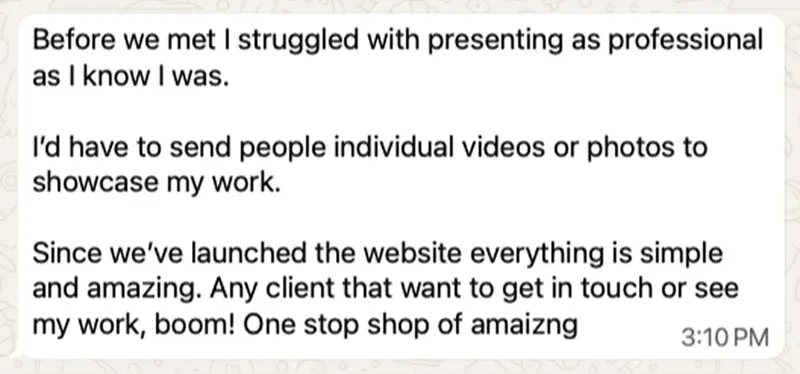
When it's done right, your website becomes the bridge between your marketing and your calendar. My client Tzviki, a fundraising coach, described it this way: "The website has become a key part of my funnel, serving as a strong bridge between my content and discovery calls. To this day, it's one of the primary ways people find their way onto my calendar."
With my Authority Engine website design process, I focus on creating clarity around your services and the next step you want potential clients to take. That means making sure your website doesn't just have a "Book a Call" button, but gives the right people a good reason to click it.
Strategy #3: Use Your Website on Purpose in Your Marketing and Sales
Lots of consultants think that all they need to do is invest in a website and wait for the leads and clients to roll in. I hate to break it to you, but that ain't gonna happen.
You need to get out there and market your business so people can find your website. Market, market, market. Even the most beautifully designed, strategically written website isn't going to magically fill your calendar if nobody is visiting it.
Your website needs to be the bridge between getting someone's attention and turning that attention into a paying client. Think of it this way: your marketing gets you in front of potential clients, your website helps those people understand your value, trust your expertise and take the next step, and your sales process helps turn the right opportunities into paying clients.
When all three work together, your existing sales and marketing efforts become a lot more effective.
Give your existing marketing a place to send people
Think about everything you're already doing to market your consulting business. Maybe you're:
- Sharing valuable content on LinkedIn.
- Guest speaking on podcasts.
- Attending networking events.
- Building relationships with referral partners.
- Sending emails to your audience.
- Having conversations with potential clients.
Every one of these activities can create interest in what you do. But what happens after someone becomes interested? If there's no clear place for them to learn more, that interest can fade before it turns into an opportunity.
That's what your website is for. Instead of relying on a single post, conversation, or introduction to explain everything about your business, you have a central place that does that work for you.
Your website can answer questions, explain your approach, show your expertise, and help people understand whether your services are right for them. And when they're ready, it gives them a clear next step to take.
Use your website to support your sales conversations
Here's another way to think about your website: it doesn't always need to be the first thing you send someone. Sometimes, it's more valuable after you've already started a conversation.
For example, imagine someone reaches out to you on LinkedIn asking about your consulting services. Instead of immediately sending them to your website and hoping they eventually come back to book a call, you could focus on moving that conversation toward a discovery call first. Once they've booked, you can send them your website and encourage them to learn more about your approach before you meet.
Now, instead of starting your discovery call from scratch, you're speaking with someone who already has a better understanding of what you do, who you help, and how you work. They can come into the conversation with better questions, and you can spend less time explaining the basics and more time talking about their specific situation and whether working together makes sense.
My client Yitzchak, a CPA and financial consultant, saw exactly this: "Bookings come in without me being involved. And when someone booked through the website they already had a good idea on what I do and how I can help them."
That's a much more deliberate way to use your website as part of your sales process.
Make it easier for other people to refer you
Your website can also be a really useful resource for referral partners.
Let's say you have a business contact who regularly meets people who could benefit from your services. They might want to recommend you, but they don't necessarily know how to explain everything you do.
With a clear, credible website, they have an easy resource they can share. Instead of trying to explain your entire business themselves, they can make an introduction and point someone toward your website to learn more.
Now that potential client can see who you help, understand your approach, and get a feel for whether you'd be a good fit. This makes the referral process easier and gives you a chance to build trust before you ever meet.
Don't expect your website to do everything on its own
Here's the important part: your website isn't a replacement for marketing. It's a tool that makes your marketing and sales more effective.
If you're not consistently getting in front of potential clients, your website probably won't solve your lead-generation problem on its own. But if you're already creating interest in your services, even on a small scale, a website built with a strategy behind it can help you get more out of that attention. And as your marketing grows, your website becomes an even more valuable part of your business.
How the Authority Engine helps
The third part of my Clarity, Credibility, Visibility framework focuses on visibility. It isn't enough for your website to clearly explain what you do and build trust with potential clients. You also need to think about how the right people will find it and how you'll use it.
Through the Authority Engine, I look at how your website can support your wider marketing and sales efforts, so it becomes a planned part of how you attract and convert potential clients.
The goal isn't just to launch a new website. It's to give you a website you can confidently use to support your business growth.
But Do You Need Thousands of Website Visitors to Get Discovery Calls?
You might be wondering: "This all sounds great, but what if I don't have a lot of people visiting my website?"
Here's the thing: you don't necessarily need thousands of website visitors every month to start getting discovery calls. What matters more is attracting the right people and giving them a good reason to take the next step.
Think about it. Would you rather have 1,000 random people visiting your website who have no interest in your services, or 50 potential clients who are actively looking for help with the exact problem you solve?
Of course, there's no guarantee that those 50 visitors will book calls. But when your website is clear about who you help, shows your credibility, and makes it easy to take action, those visits have a better chance of turning into real opportunities.
And remember, those website visitors don't all have to come from Google. They can come from your LinkedIn content, your email list, your networking, your referral partners, or the conversations you're already having. Every one of those activities creates chances for the right people to learn more about your business, and your website helps turn that interest into trust and, hopefully, booked discovery calls.
Now, if you're not getting in front of potential clients at all, that's something you'll need to work on too. A website can't replace a consistent marketing strategy. But if you're already getting some interest in what you do, a website with a plan behind it can help you make better use of the attention you're getting.
Your Website Should Help You Win More Clients, Not Just Look Good
Getting more discovery calls booked from your website isn't just about having a modern design or putting more "Book a Call" buttons on your homepage. It's about building an experience that helps the right people see your value and feel confident taking the next step.
And it starts with three strategies:
- Make your website do more of the selling for you. Clearly communicate the problems you solve, explain your approach, and show potential clients why you're someone worth working with.
- Make your discovery call an easy and valuable next step. Give potential clients a clear reason to book a conversation and help them understand what they'll get out of it.
- Use your website on purpose in your marketing and sales. Make it a central part of how you educate prospects, support referrals, and move interested people toward becoming clients.
When you put these strategies together, your website can start doing a lot more for your business. Instead of just sitting there as an online brochure, it becomes a place where potential clients can get to know you, understand your expertise, and take that next step toward working together.
And the more qualified discovery calls you can get, the more chances you have to bring in right-fit clients, build consistent revenue, and grow your business. Because at the end of the day, your website shouldn't just make your business look good, it should help your business grow.
Ready for a Website That Helps You Book More Discovery Calls?
I help consultants who are already generating interest but aren't closing the deals they want at the rates they're worth.
If that sounds like you, and you're ready for a website that does more than look professional, I'd love to help. My Authority Engine is a website design process built around my Clarity, Credibility, Visibility framework. It's designed to help you build a website that clearly communicates your value, builds trust with potential clients, and supports your marketing and sales.
So instead of wondering whether your website is actually helping your business, you'll have a clear strategy behind how it supports your growth.
And I only win if you win. If you don't make at least $10,000 more within 12 months, either directly from your website or through growth above your previous baseline, I'll get on a call with you, figure out what's not working, and fix it for free. The one condition is that you're actively marketing, because like I mentioned earlier, a website can't do that part for you.
The first step is a Website Strategy Call. We'll look at how people find you right now, how they buy, and where they might be falling through between the two. If I can help, I'll show you how. If I'm not the right fit, I'll tell you that too.