Authority Building
Why I Created The Authority Engine
Oct 21, 2026 · 13 min read

You've built a successful coaching or consulting business. Your clients love working with you, and referrals keep coming because you're genuinely good at what you do.
The problem is when a potential client finds you, for some reason you feel like you have to work twice as hard to convince them you're worth hiring. And it feels gross. You got into this business to help people, not to become a pushy salesperson.
Ideally, by the time said potential client gets on the phone with you, they already understand what you do, believe you can solve their problem, and trust you enough to seriously consider working with you.
But for a lot of coaches and consultants, that trust is not there yet, and even though they have loads of experience and they get really great results for their clients, it still feels like nobody sees that expertise until after they start working with them.
So when they raise their prices, try to attract better clients, or move into the next stage of their business, prospects start hesitating. Deals take longer. People ghost. Discount requests show up. And sales calls start feeling like a long exercise in proving why you are worth it.
Often, the problem is surprisingly simple: you’re ready to charge more, but your website doesn’t make people trust you enough to pay you more.
That is the problem that eventually led me to create The Authority Engine.
I didn’t start out thinking this way about websites
I got into web design in high school. I took an intro to websites class and quickly realized that I wasn’t too shabby at making sites. Before the end of that year, I landed my first ever paying client at my sister's bat mitzvah (this is back in 2020 by the way) and during that period of my life I only cared about one thing: Making each and every website I built look like a beautifully designed masterpiece.
But as I started working with more and more businesses, I started noticing that a website is not really an art project, and more of a business tool, designed to help a business grow and make more money. Not just look pretty online.
In my first year in business in 2020- I launched two websites back-to-back. One was for a video marketing agency and the other was for a Realtor. Both websites were solid. And even though I was a newbie they were still pretty well made (if I do say so myself 😉)
My video marketing agency client grew his business from $70,000 in annual revenue to around $180,000. Which was a major win! 110,000 in added annual revenue! My Realtor client, on the other hand, saw basically no increase at all.
It was driving me crazy, both businesses had gotten good websites. So why did one see a huge shift while the other barely moved? You could look at that and say, “See? Websites don’t really matter.” But I knew that wasn’t true either, because of the 6 figure increase from my other client…
Which led me down the rabbit hole where I started asking questions to figure out how I can make my work more effective.
What actually makes a website create value for a business?
The more clients I worked with, the clearer it became: the businesses getting the most value were the ones who saw the website as a tool they can integrate into their existing marketing efforts to get better results.
They knew that their website’s job was not to generate leads and sales from scratch. It was to help more of the existing attention turn into trust, sales, and better paying clients.
That became one of the biggest shifts in what I think your website's job is in your business: it is the bridge between your marketing and sales.
Marketing gets people to you → Your website turns that attention into trust → Sales turns that trust into a buying decision.
Your website's job is to help the people who find you turn into qualified leads, and then help turn those leads into sales because they already understand what you do, see you as the expert, and believe you are the right person to help them solve their problem.
Meaning that not only are they more likely to book a call - but the sales call itself is much easier. You’ll spend less time trying to convince people, they are able to be more confident in their decision to hire you - and you are able to charge what you know you’re worth.
Even if your website isn’t generating tons of traffic the people visiting your website aren’t random schmoes. They’re potentially some of the hottest leads you can possibly generate. Because people don’t visit websites for fun- they are visiting because they are interested in solving a problem
Maybe they came from one of your posts. Or someone referred them to you. Or maybe they’ve been following you for a while and thinking, One day, I’d love to work with this person. And your website is shaping that decision. It is either reinforcing the idea that you are the expert they thought you were, someone worth trusting and spending thousands of dollars with, or it is making them question that belief.
The two questions every website must answer to actually convert
When someone is making a decision that big, your website needs to answer two very simple questions:
Can you solve my problem?
Can I trust you to deliver?
If your website does a good job of showing people that you understand their problem, that you can solve it, and that you are worth trusting, it can build trust long before someone ever gets on a call with you.
And if it doesn’t, one of two things can happen. A) They still book the call, but come in expecting something cheap because your website does not make you look as premium or professional as you actually are. B) Or worse, they never even book the call in the first place.
I struggled to explain the value of my work
The funny thing is, even though I believed the work I was doing was helping businesses, I still had doubts. Was I really the expert? Was I actually creating that value? There were so many other pieces at play.
So even though I could see my clients building more trust, getting warmer prospects on sales calls, and feeling more confident in how they showed up, I still had a hell of a time explaining why the work was creating so much value.
There was never one obvious lever I could point to. A website touches almost every part of a business: trust, marketing, sales, pricing, and perception, all at once. So when a client got a huge result, part of me would wonder: Was that really because of the work I did? Or was it timing, luck, their marketing, or something else happening in the business?
So I started looking for answers
During COVID, I started investing much more seriously in my own growth.
I took a web design course through Flux Academy. I hired my first business coach. I got introduced to Alex Hormozi’s work, read his book on offers (and later his books on leads and money models), and started thinking much more seriously about what I was actually selling.
Then, at 22 years old, I made the biggest investment of my life. I hired a coach for $12,000 who specialized in helping coaches generate leads.
At the time, I really believed I needed more leads. But I also told him something else I was struggling with: I did not fully understand the value of my own work.
He looked at what I was doing and told me it was absolutely worth the money I was charging.
But that still was not enough.
Someone else telling me, “Your work is valuable,” did not magically make me understand why it was valuable, who it was most valuable for, or how to explain that value in a way that made sense to a potential client.
So even though I was DMing cold prospects on LinkedIn and booking calls, I did not manage to close a single client from it. I was getting people on the phone, but I was still struggling to help them understand the value I knew I was creating.
But I didn’t give up. I hired a different coach for $10,800 and kept learning as much as I could about offers, marketing, sales, and growth - trying to crack the code for understanding how to communicate my value.
And although I can’t say for sure exactly when, somewhere along the way, the way I thought about business started to shift.
At its core, business is a value exchange. And if you can’t clearly communicate why what you do is valuable, you’re going to struggle to market it, sell it, and grow it. End of story.
By this point, I knew how to design. I was learning how to market. I was learning how to sell. But I still couldn’t clearly explain the most important thing: What was the deeper transformation my work was actually creating for my clients?
Then I finally looked at the numbers
Eventually, one of my coaches told me something ridiculously simple: You need to know your numbers.
So I went back and surveyed 12 of my clients and asked how much revenue they made before and after - one year before and one year after we launched their authority engine website.
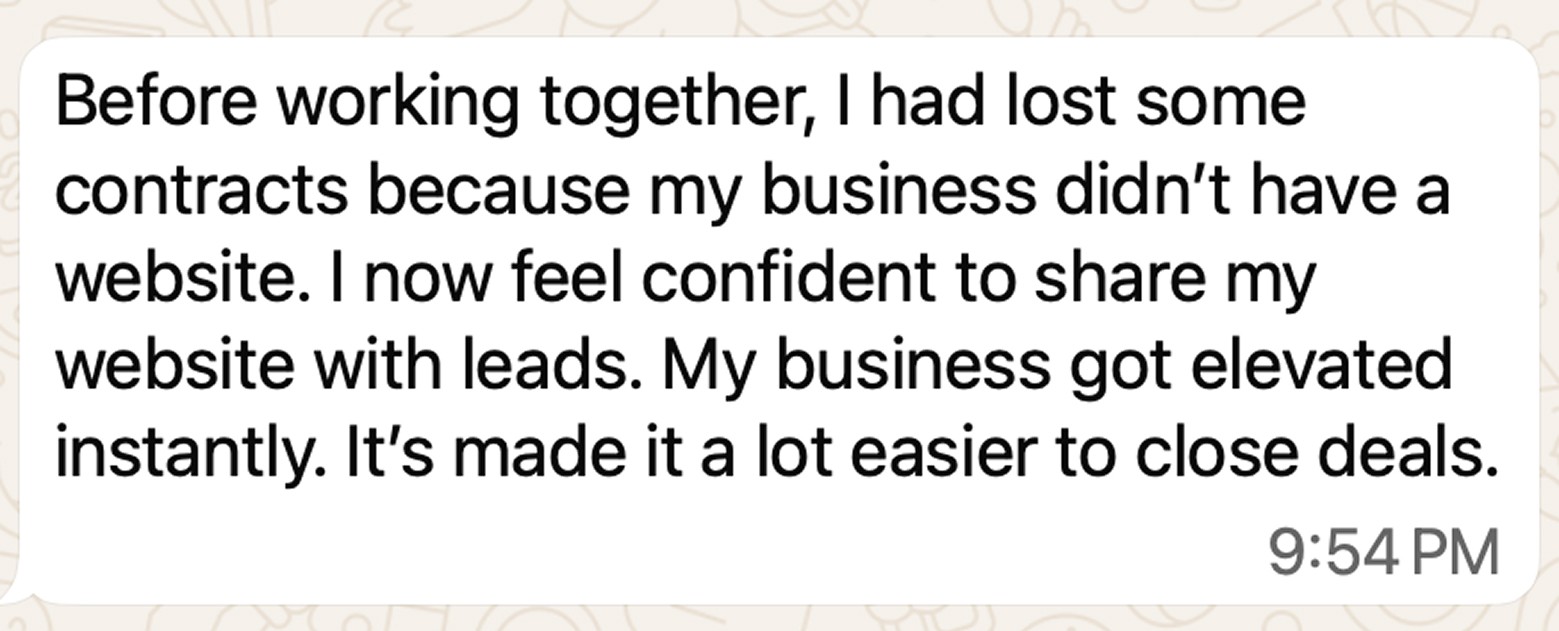
On average, they reported a 12x return on what they invested with me, an 86% increase in revenue, and $60,350 in additional annual revenue in their first year.
And for the first time, I had concrete proof that what I do, can create massive change to my clients businesses and lives.
My clients weren’t spending thousands of dollars with me and walking away with (just) a sexy website- For the right business, MY work was helping them make significantly more money.
And more importantly, these stats helped me finally understand what I had been seeing for years. The website wasn’t magically creating the growth. My best-performing clients already had existing expertise, a valuable service, and people paying attention to them.
What changed was how well they converted that attention into dollars.
More people trusted them. More leads became clients. They raised their prices. Their marketing worked harder because when someone checked them out, their online presence backed up everything they had been saying.
That was the moment the idea really clicked for me: When you turn on authority, you get more value from the attention you already have.
And once I understood that, I stopped looking at my work as “building websites.” I started looking at the business first and asking a much better question: What is stopping this business from growing and how can this website help fix it?
Esty’s story made the problem impossible to ignore
One of the clearest examples was my client Esty Rosenfeld. She was already a talented marketer. She had experience, clients, and a proven method for getting her clients results.
But she told me about a meeting with a larger company where one of the decision-makers looked at her and essentially asked:
“Why should I trust you?”
He could not easily see her results. She did not have a website that supported the level of service she was offering. She was an expert. But the way she was showing up - did not match it.
After we worked together, Esty described the website as a catalyst. She reported that her income was up 77% in just 90 days after we launched her website.
Esty shared with me that since launching: she started taking herself more seriously. She raised her rates. She stopped feeling embarrassed when people asked for her website. Overall she felt more confident in how she presented the business.
Her service was already premium. The problem was that she did not look as premium as the work actually was. That is the authority gap. And once I started seeing it, I saw it everywhere.
The authority gap shows up in a 3 different ways
- Sometimes it shows up as a trust problem.
A coach or consultant raises their price, but prospects do not trust them enough to pay it. Sales calls drag on. People hesitate. Prospects ghost. They ask for discounts or choose someone else.
- Sometimes it shows up as a confidence problem.
The expert is doing good work and creating good content, but when someone asks for their website, they cringe. They are hesitant to advertise because they are not confident about where the traffic is going. Their LinkedIn profile looks great, but the website feels like it belongs to a smaller version of the business.
- Sometimes it shows up as a communication problem.
They know what they do, but when someone asks them to explain it, they launch into a megillah. They struggle to clearly say who they help, what problem they solve, what makes their process different, and why someone should choose them.
All three problems feed into the same thing: A prospect has to understand you and trust you before they will pay you.
That is why I became obsessed with clarity and credibility
Over time, I realized that trust is not something you create by throwing a few testimonials onto a homepage. A potential client first needs clarity. They need to understand what you do, who you help, what problem you solve, how your approach works, and why your solution is valuable.
Then they need credibility. They need to believe you can actually deliver. That comes from things like testimonials, case studies, results, experience, professionalism, and a clear process.
But the proof by itself still isn’t enough. A potential client can look at a giant ROI claim and think, “Great... but that person is nothing like me.” Or worse, they hire you expecting the exact same result, only to realize afterward that your process was never really a fit for their situation.
That’s bad for everyone. You end up with a frustrated client who came in with the wrong expectations, and they end up feeling like they bought something that was never really meant for them. So your website has to do more than prove that you’ve gotten great results before. It needs to help the right person understand why your service makes sense for their specific problem.
They need to see how you think, understand the process you use, and that you have a repeatable way of helping them create a transformation. That combination of clarity and credibility is what builds trust.
But trust does not exist in a vacuum. Your website sits between your marketing and your sales. So if your marketing is not bringing the right people in, or your sales process is weak once they get there, even a great website can only do so much.
The strongest clients were not starting from zero
Another pattern became clear as I looked at the clients who got the biggest wins: they already had some form of marketing and sales working.
They were already getting in front of potential clients, generating interest, and making sales.
That mattered because an Authority Engine website acts like a multiplier on the business you already have. The stronger your marketing and sales are, the more there is for the website to multiply.
Your website sits right between your marketing and your sales. Your marketing creating attention and your sales process converts that attention to cold hard cash.
The Authority Engine is designed to make that transition from marketing to sales as seamless as possible. So more of the right people understand your value, trust your expertise, and book a discovery call already believing that you’re the right person to help them.
But even the strongest multiplier can only multiply what is already there.
I had one client who was a chef doing private dinners. Her business went from around $20,000 a year to $40,000. She was already getting referrals, and the website helped make those referrals stronger and more likely to convert.
Another client was a financial consultant who was already marketing and generating a few leads per week. After launching his website, his lead flow increased by 7x, and leads started coming in pre-sold on his services. His business went from around $180,000 to $350,000.
In both cases, the growth was significant. But the financial consultant already had more marketing and a stronger sales process in place, which meant there was simply more for the website to multiply.
The Authority Engine is not just a pretty website. It is designed to maximize your clarity and credibility so the right people understand what you do, trust that you can help them, and take the next step.
That thinking became The Authority Engine Method™
Eventually, I realized I was not really selling “a website.” The website was the vehicle.
The deeper work was making sure a potential client could understand the value of the business, see why this person was the right fit for their problem, and trust that they could actually deliver on what they were promising.
Once I understood that, the work became much easier to define. It was not just design, and it was not just messaging. It was a process for building the clarity and credibility that make trust possible.
That became The Authority Engine Method™, and it has three parts.
Clarity
Before we design anything, we get clear on the business.
- Who do you help?
- What problem do you solve?
- What is that problem costing them right now?
- What becomes possible when it is solved?
- What makes your approach different?
- Why should someone choose you?
This is the positioning and strategy work that everything else depends on.
Credibility
Then we take that strategy and turn it into a website that makes you look as good as you actually are.
The goal is not to impress someone with design for the sake of design.
The goal is to help the right prospect land on your website and think:
“Wait. This is exactly what I need.”
The website becomes the home base of the business.
It communicates your expertise, shows your proof, explains your process, and makes it easy for someone to move into your sales process.
For many coaches and consultants, that means making it easy to book a discovery call.
Instead of starting every sales conversation from scratch, you can have prospects arrive already understanding what you do and why it might be relevant to them.
Visibility
The third piece came from seeing how different the results could be depending on how much attention was flowing into the business.
A great website still needs people to see it.
That is why I added the visibility side of The Authority Engine: resources around content, email, outreach, and choosing the marketing strategies that make sense for the specific business.
Because a website does not replace marketing.
Visibility gets people to you. Clarity and Credibility is what gets them to buy.
The real goal is not a better website
The transformation I care about is much bigger than design.
I want my clients to internally understand why their work is the best option for their ideal clients, help them build more trust in the market, and help them access better clients, giving them more leverage to charge higher rates.
When that happens, you are able to market confidently, sending prospects to a strong conversion tool that turns that attention into hot leads.
Sales gets easier because prospects come in pre-sold on your solution. Which means, you do less convincing. You get more choice over who you work with. You are less likely to lower your standards just because you need the sale.
And instead of feeling like your online presence is holding you back, it starts reinforcing the level of business you are trying to build. That is the whole point.
I think this is only going to matter more in the age of AI
The market is changing, there was a huge explosion in coaching, courses, programs, and online services. A lot of big promises were made, and not everyone delivered on them…
People didn’t stop investing. But they raised the bar for who they are willing to invest with.
I see that in my own buying behavior too. When I consider hiring someone, I look at their testimonials. I look at their case studies. And I 1,000% check out their website.
But even then, I am not just looking for proof. I still need to understand what makes their service the right option for my specific problem.
That becomes even more important as AI makes it easier for almost anyone to publish polished content, build a decent-looking website, and sound like an expert.
The market is going to get flooded with people who can pass as experts without actually having the depth of experience behind it.
And that creates a new problem for the people who really are experts.
You can be incredibly good at what you do and still end up looking almost identical to someone who took a two-day course, used AI to write polished copy, built a professional-looking website, and started calling themselves an expert.
The surface-level signals are getting easier to copy. That makes it harder for potential clients to tell who actually knows what they are doing.
So having real expertise is not enough if nobody can see it.
You can have years of experience, great results, strong judgment, and a proven process, but if your website makes you look generic, unclear, or no different from everyone else in your space, that expertise is getting lost.
That is where my work comes in: My job is to take the expertise that already exists in your head and your business, make it clear, make it credible, and build an online presence that helps the right people recognize its value.
Because in a world where almost anyone can look polished, real experts need to level up how they communicate their expertise, so potential clients can instantly understand why they are worth a premium- that is the future I want The Authority Engine to help create.
Is your online presence keeping up with your expertise?
If you’re already doing great work, marketing your business, and generating interest, but too many prospects are still hesitating before they buy, you probably don't have a traffic problem.
Most likely you have an authority problem.
Maybe prospects are booking calls but not closing. People show interest and then disappear. Maybe your sales calls feel like long exercises in convincing. Maybe you are attracting clients, but not the caliber of clients you really want. Maybe you are ready to charge more, but your online presence still feels like it belongs to an earlier version of your business.
Or maybe someone asks for your website and, if you are being honest, you still cringe a little. If any of that sounds familiar, The Authority Engine may be the right next step.
You can book a discovery call, and we will look at where you want your business to go, what is currently getting in the way, and whether strengthening your authority online is likely to create enough value to make sense for you.
Because if you’ve already put in the work to become an expert- your online presence should reflect that.